-
A-A+
- Українською
- Українською
English
English
Statement on transparency in military exercises and activities (OSCE FSC)
23 June 2021 19:35
Delivered by Nataliia Kostenko, Deputy Permanent Representative of Ukraine to the International Organizations in Vienna, to the 980th meeting of the OSCE FSC, 23 June 2021
Mr. Chairperson,
We are grateful to the Armenian FSC Chairpersonship for bringing this important topic to the attention of the Forum. We welcome the speakers and thank them for their contribution to our discussion today.
The Vienna Document 2011 remains the cornerstone politico-military instrument to ensure transparency measures over military activities of participating States, when implemented in letter and spirit. Especially important such measures become in case of no-notice large-scale military exercises taking place near the borders.
At the same time, we believe in the need to pursue our efforts in modernizing the Vienna Document 2011 to enhance politically binding transparency measure. In particular, such amendments should include reducing the thresholds for prior notification and observation of military activities, improvement of risk reduction mechanisms, and enhancement of the effectiveness of verification measures.
The joint proposal supported by 34 participating States addresses these goals. We encourage all delegations to take part in the modernization efforts to enhance transparency and predictability in the region.
The political will and more importantly genuine interest to follow this path is essential.
Ukraine is committed to the Vienna Document despite challenging security conditions that it faces, defending its sovereignty, territorial integrity and independence. In a spirit of openness and transparency, we have enabled other participating States to conduct above-quota inspections in areas of concern. Since 2014, the participating States have been regularly conducting such inspections, also in the Donbas region of Ukraine.
Ukraine has expanded the scope of inspections, allowing the inspection teams to receive a wide range of briefings from regional authorities and other State institutions.
Additionally, in order to strengthen confidence and security at the regional level, Ukraine is steadfastly fulfilling its obligations under bilateral agreements with neighbouring countries, which were concluded in accordance with Chapter X (“Regional Measures”) of the Vienna Document. Reciprocal inspections and evaluation visits, prior notification of military activities below the threshold levels under these agreements contribute to enhancing transparency and predictability in the region.
Taking into account our national experience, along with modernization of the Vienna Document 2011, we believe in the need to further develop regional CSBMs; to lower the thresholds for the observation of military activities in the vicinity of borders; to ensure military transparency within 25 kilometres of border areas by providing the possibility of inspections and observation flights.
Esteemed colleagues,
Since the beginning of 2014, Ukraine has been facing the consequences of untransparent large-scale no-notice military activities near its border. This instrument has been used by Russia to unleash armed aggression, invade Ukraine, and occupy parts of its sovereign territory. These gross violations of our agreed principles and commitments and imperative norms of international law remain unabated to this day.
Back in 2014, Russia conducted snap checks of troops in the Southern and Central Military Districts as well as the airborne command. Over 38 000 troops, 760 tanks, up to 1200 armoured combat vehicles and up to 720 units of artillery systems were involved in the drills that also took place near the border with Ukraine in the Western Military District. Apparently, such massive military build-up raised serious concern of Ukraine, which distributed a relevant format (CBM/UA/14/0016/F10/O) to seek explanation.
According to numerous reports from open sources, the Russian media and third countries, a large group of troops, which considerably exceeded the numbers notified by Russia, completed their concentration on training fields to further carry out a combined thousand-kilometre marches to unscheduled areas as part of strike groups.
This activity was way outside of the scope of usual military activity and was regarded as actions directed against Ukraine, which eventually led to seizure of Crimea in March 2014.
Since 2014, Ukraine has sent 36 F-41 formats expressing its concern over unusual military activity of the Russian Federation.
In the course of past years, the Russian Federation increased the number of military exercises on the Western and Southwestern strategic directions. The annual strategic command-and-staff exercises encompass working out of elements of offensive operations, including full-scale military operations.
In total, about 100-130 thousand servicemen are involved in strategic exercises every year. At the same time, Russia officially significantly reduces the number of troops involved, using various loopholes of the Vienna Document 2011 to circumvent the thresholds for prior notification and observation.
Under the guise of scheduled measures of operational and combat training, primarily those pertaining to the preparation for final checks of troops, the covert deployment of the elements of command-and-control system of wartime task forces on specified directions is carried out. The enhancement of the command-and-control system of military districts is performed by deploying field command posts near the border with Ukraine and in the temporarily occupied Crimea.
Mr. Chairperson,
In the period from March 18 to April 23 this year, under pretext of snap checks of troops (forces), Russia increased its military build-up near the state border with Ukraine and in the temporarily occupied Crimea to 50 battalion tactical groups. Additional 22 battalion tactical groups, 13 tactical groups and 3 special operation units were redeployed to these areas, amounting to 16 thousand servicemen. Moreover, the auxiliary command points were deployed on the specified directions. The naval component was strengthened by four large assault ships from Northern and Baltic fleets and a detachment from Caspian Flotilla. In order to strengthen the aviation component, up to 50 operational and tactical aircraft and up to 30 helicopters of the Southern military district were redeployed to the temporarily occupied Crimea.
As of 22 April, this year, the total number of Russian troops reached more than 105 thousand servicemen, which significantly increased the level of military threat to national security of Ukraine and the region.
According to the statement of the Russian Federation, after the completion of the inspection of troops (forces), units of the Russian armed forces returned to their peacetime locations. However, this statement is only partially true, as a significant number of personnel, weapons and military equipment remained in their concentration places.
These facts illustrate that due to the fragmentation of large-scale exercises and manipulation of the provisions of the Vienna Document 2011, Russia conducts its military activity that is subject to chapters V and VI of this document but fails to notify of it in the prescribed manner.
In light of these provocative military manoeuvres this year, Ukraine invoked the risk reduction mechanism under the Vienna Document 2011, seeking to dispel concerns and deescalate tensions. However, the Russian Federation failed to fulfil its commitments under Chapter III by not providing substantial information over its military activities, including the withdrawal of its forces, and disengaging from a meaningful dialogue. Despite numerous calls of the participating States, the Russian side refuses to provide adequate transparency measures. It is reluctant to explain how this large-scale military activity did not fall under the thresholds for prior notification and observation.
It is clear, that these untransparent large-scale no-notice military drills of the Russian Federation have been used yet again to mask the redeployment of additional forces and assault weapons to its western border. This instrument has been widely used by Russia since 2014.
Russia eschews necessary measures of transparency and verification during its large-scale military activity to project the threat of force vis-a-vis its neighbours, prepare the ground for military interventions and escalation of tensions in the temporarily occupied territories of Ukraine as well as at the border areas with its neighbours.
Such behaviour significantly increases the risks to European security and destabilizes the region.
In conclusion, I would like to invite you to watch a short video depicting some facts of redeployment and concentration of weapons and military equipment of the Russian armed forces near the border with Ukraine and in the temporarily occupied Crimea.
Video 1.
This video was filmed at Dvubratskyi-Ust-Labinskaya station crossing (Krasnodar Krai, Russia) on 27 March 2021. It shows the movement of echelon with military equipment on the platforms. The tactical signs on the equipment confirm that it belongs to the 19th Motorized Rifle Division (Vladikavkaz) of the 58th General Army of the Southern Military District. On 26 March 2021, the echelon left the territory of North Ossetia in the direction of the temporarily occupied Crimea.
Video 2.
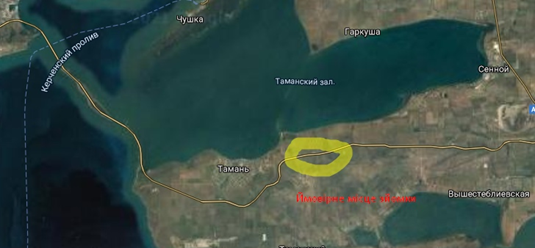
This video was filmed on 25 March 2021, on the Taman Peninsula. It shows the movement of the echelon with military equipment consisting of MLRS "Grad" – not less than 20 units; military trucks – not less than 10 units. In addition to the platforms with equipment, the echelon consisted of two covered freight cars and four passenger cars.
Scheme of the area of movement of the railway echelon
 Video 3.
This video was filmed on 30 March 2021, in the temporarily occupied Crimea. It shows a railway echelon with military equipment of the 136th separate motorized infantry brigade (Buynaksk) of the 58th General Army of the Southern Military District. On 27 March 2021, the echelon left Dagestan for the temporarily occupied Crimea. It carried at least 18 infantry fighting vehicles BMP-3, one amphibious armoured personnel carrier BTR-80 and three military trucks.
Video 4-6.
On the next 3 videos, filmed on 30-31 March and 7 April 2021 in the city of Voronezh near Maslovka railway station you may see:
- (4) the movement of a convoy of military trucks with the license plates of the 76th region, which is a part of the Central Military District, heading to Pogonovo training range.
- (5) the concentration of military units of Central Military District. Later observed in Pogonovo training range.
- (6) military air defence equipment, including 9A317M SAM "Buk-M3" surface to air missile system, which belongs to one of the air defence units of the Central Military District.
Video 7.
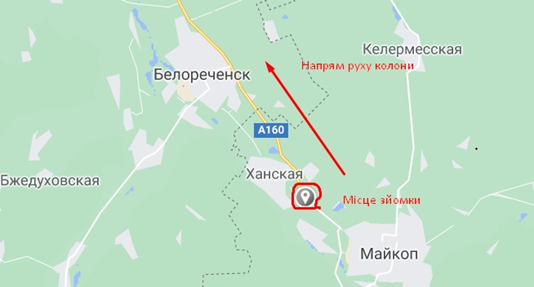
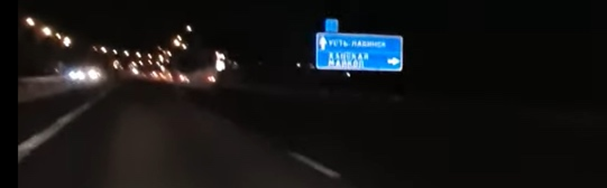
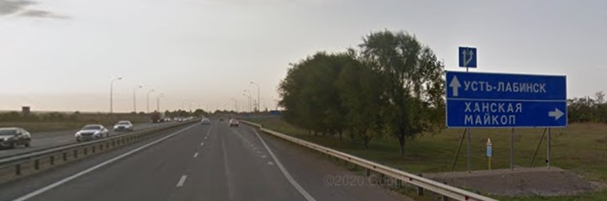
This video was filmed on 26 March 2021, north of the city of Maykop. It captured the movement of a military convoy with tactical missile systems Iskander that belongs to one of the missile units of the Southern Military District. The convoy was moving along the A160 highway in the northern direction towards Ukraine. The convoy included two Iskander launchers, two 9T250 transporter-loader vehicles and 12 military trucks.
Scheme of the area of movement of the convoy with Iskander
 Geo-tagging
 Video 8.
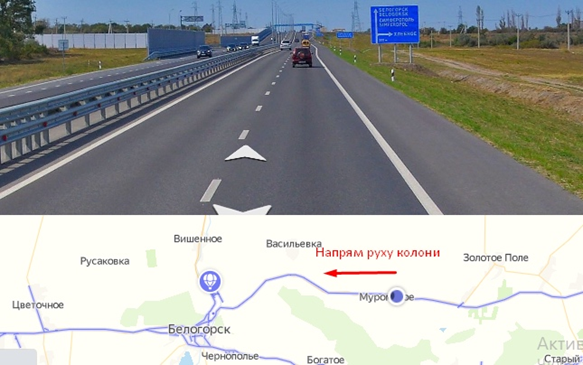
This video was filmed on 01 April 2021, near the residential areas of Muromske and Khlibne. It shows the movement of a military convoy along the route "Tavrida" (the temporarily occupied Crimea). The convoy consisted of more than 20 vehicles, including military radio stations on the basis of "Kamaz". The license plates of the vehicles included the code of the 21st region, which is part of the Southern Military District.
Geo-tagging
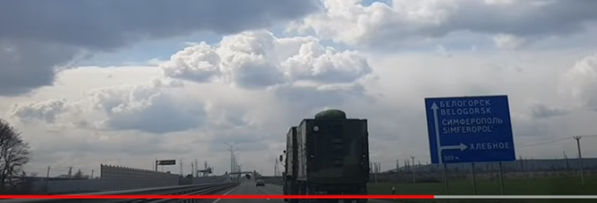
Scheme of the area of movement of the convoy
The full video is available via the link:
https://drive.google.com/file/d/1Qw_uGsdGG-Ro65vX2XEB1b6QxwNzl9ee/view?usp=drive_web
Thank you, Mr. Chairperson.